
A feral child is a human child who has lived away from human contact from a very young age and has little or no experience of human care, loving or social behavior, and, crucially, human language. Feral children may be confined by humans (often parents), raised by animals, or isolated in the wild.
Raised by wolves
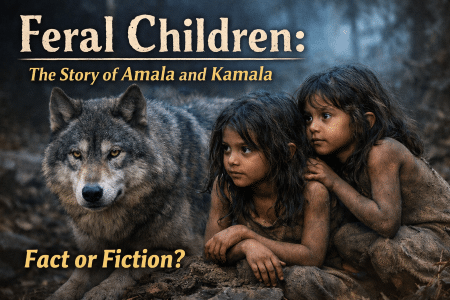
Probably the best-known story of feral children is that of two girls, Amala and Kamala, who were reported to have been raised by a she-wolf.
In 1920, Reverend J. A. L. Singh claimed to have observed a mother wolf with cubs, two of whom appeared human. After considerable effort, the two children were captured. They were identified as girls, whose ages Singh estimated to be about 8 and 1.5 years, respectively.
Acting like wolves
The children were taken to an orphanage in Midnapore, India, where the Reverend and his wife were stationed. Singh described them as “wolfish” in appearance and behavior.
According to his reports, they moved on all fours and had calluses on their knees and palms. They were said to prefer raw meat, to lick liquids rather than drink them, and to eat in a crouched position. Their tongues reportedly hung out of their mouths, and they panted like animals.
They were described as being active at night, howling and roaming after midnight. Singh also claimed that they moved quickly, avoided human contact, and reacted defensively when approached. Their hearing and sense of smell were said to be highly developed, and they reportedly navigated better at night than during the day.
In September 1921, both girls became ill, and Amala, the younger, died.
Kamala learns to be human
According to Singh’s account, through patient and consistent care, Kamala gradually became more responsive to human interaction. Mrs. Singh reportedly worked closely with her—feeding, comforting, and physically caring for her—to build trust.
After several years at the orphanage, Kamala demonstrated some cognitive and social development. She reportedly learned to recognize certain people, understood simple concepts such as color, and could identify her own belongings.
As for language development, a visitor, Bishop H. Pakenham-Walsh, described her progress:
“When I saw Kamala she could speak, quite clearly and distinctly, about thirty words; when told to say what a certain object was, she would name it, but she never used her words in a spontaneous way. … I saw her again two years later … and she had learned a good many more words.”
Kamala dies unexpectedly
By this time, Kamala—and the Singhs—had gained considerable attention. The Psychological Society of New York reportedly invited Kamala to the United States in 1928. However, this did not occur because of her declining health.
Kamala became increasingly weak and died on the morning of November 14, 1929.
Controversy and modern interpretation
Today, the story of Amala and Kamala is widely debated. Much of what is known comes from Reverend Singh’s diary, published years after the events and lacking independent verification.
Modern researchers have raised serious doubts about the accuracy of his account. Some suggest that the children may not have been feral, but rather children with developmental disorders who had been severely neglected. Others argue that elements of the story may have been exaggerated or misinterpreted.
Because of these concerns, the case is no longer considered reliable scientific evidence for the claim that children are raised by animals. Instead, it is often discussed as a historical account that highlights both the effects of extreme deprivation and the importance of critically evaluating sources.
Other reported cases of feral children
There are many other stories of feral or isolated children in the literature. These include reports of a boy in Syria who survived by eating grass and moving with unusual agility, and a girl in Indonesia who reportedly lived in the forest for several years after being separated from her family.
As with the case of Amala and Kamala, many such accounts should be approached with caution, as details are often difficult to verify.
Watch this video about Amala and Kamala and nine other cases of children raised by animals:
.
.
Edublox provides support for students with dyslexia, dyscalculia, and other learning difficulties. We help students worldwide overcome academic challenges and reach their full potential. Book a free consultation to discuss your child’s learning needs and discover how we can help.
.